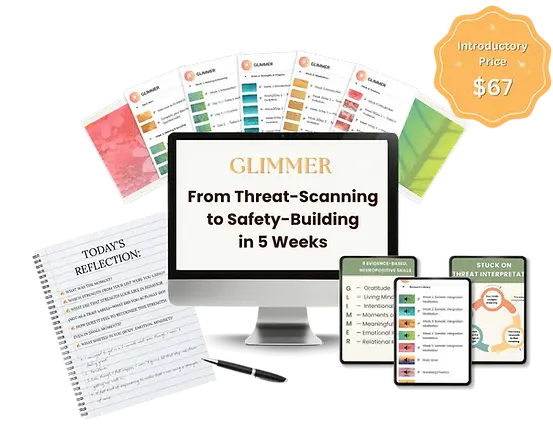
Positive Neuroplasticity Training

GLIMMER for Clinicians
BETWEEN-SESSION SUPPORT FOR HYPERVIGILANT PATIENTS
For your patients who understand the work in session, then spend the rest of the week scanning symptoms, bracing for setbacks, and waiting for the other shoe to drop.
The GLIMMER method gives them a simple 10-minute daily practice to help their nervous system notice safety, steadiness, and capacity alongside threat.

What GLIMMER Clients Are Saying
"The simple, steady tasks are a wonderful guide throughout the weeks. The program is great at breaking things down into the smallest, doable steps."
~Sophie, Switzerland
"The course is very straightforward. It's easy to fit into your day, without taking up too much time. The practices each day are very practical."
~Micah, Vancouver, B.C.
"What surprised me was how much I was focusing on symptoms each day, and ignoring all the good things happening around me. GLIMMER helped me become aware of this and be more intentional."
~Diane, Tennessee
"What surprised me was that seeking the small joys made such a big difference in my nervous system regulation."
~Kelli, Seattle
"I notice I feel a little more hope, and my sense of agency has increased."
~Annette, Texas
"When asked which practices they wanted to continue: 'All of them, honestly. I plan to go back and redo the five weeks.'"
~Anne, Ohio
"EVERYONE needs to take this course!"
~Malia, Seattle
The Clinical Gap:
Support between Sessions
To progress faster, many patients do not necessarily need more insight.
They need actionable, repeated, embodied practice.
In session, a patient may understand that their symptoms are safe, their body is not broken, or their nervous system is overprotective.
But once they leave your office, their attention often returns to:
-
Monitoring symptoms
-
Bracing for setbacks
-
Checking for danger
-
Researching sensations
-
Ruminating
-
Predicting relapse
-
Waiting for the other shoe to drop
For a threat-trained nervous system, safety does not always register automatically.
GLIMMER gives patients a clear daily roadmap for the hours between appointments.
It helps them practice noticing small, real cues of steadiness, support, comfort, connection, agency, and capacity — not instead of what is hard, but alongside it.
The clinical aim is simple:
Help the threat-scanning brain practice registering safety.

What GLIMMER Is
Over five weeks, patients complete a brief daily practice that helps them widen their lens, so their brain stops focusing only on what is hard, threatening, or uncertain, and starts noticing what is also safe, steady, relieving, supportive, or okay enough right now.
Those moments can be tiny and easy to miss. GLIMMER teaches us to notice, savor, and let them truly be felt in our body and registered by the nervous system.
That’s how the brain begins to learn something new: Safety is something I can build.
GLIMMER is a simple 5-week program. It is delivered via a mobile app or desktop and is designed for patients with limited energy, high symptom sensitivity, and overactive threat monitoring.
-
Each week includes a short video lesson explaining the nervous system skill being practiced.
-
Each day, patients practice noticing, savoring, and integrating small signals of safety, steadiness, connection, relief, progress, or capacity.
The daily rhythm
☀️ Morning prompt
A short prompt provides a gentle lens for the day. No extra task. No performance. Just a cue for awareness of what to look out for that day. Think of it like a 'treasure map for the day'.
🌛 Evening reflection
-
A 7-minute guided journaling practice helps the patient recall what felt neutral, okay, steady, supportive, relieving, good, or possible.
-
Somatic integration: A 3-minute audio helps those cues imprint in the nervous system one more time.
Total time: about 10 minutes a day.

What GLIMMER Is Not
GLIMMER is not a replacement for psychotherapy, medical care, psychiatric care, Pain Reprocessing Therapy, trauma treatment, or pain psychology.
It does not ask patients to:
Deny pain or symptoms
Pretend they are fine
Think positively over distress
Stop medications or medical treatment
Process trauma independently
Track symptoms obsessively
Push through limited capacity
GLIMMER is a structured, gentle skills practice.
It helps patients notice:
“Something may be hard right now, and something may also be safe, steady, or supportive.”
That “both/and” capacity is the heart of the work.
Why Clinicians Refer to GLIMMER
GLIMMER is designed for the gap between appointments, when patients are often alone with symptom monitoring, fear, rumination, and uncertainty.
Between-session support
Face-to-face work matters. But nervous system learning happens through repetition. GLIMMER gives patients a simple daily practice so they are not left wondering what to do after they leave your office.
Waitlist bridge
For patients waiting to begin care, GLIMMER offers a gentle, productive starting point. It gives them something structured to practice without positioning itself as a substitute for therapy or medical treatment.
Low-energy starting point
Many patients with chronic pain, fatigue, Long COVID patterns, burnout, or ME/CFS-pattern symptoms cannot tolerate intensive programs. GLIMMER is intentionally brief: about 10 minutes a day.
Foundation before deeper work
Some patients may be too overwhelmed to start deeper therapeutic work right away. Before advanced techniques like trauma processing or cognitive restructuring can work, they first need to build a basic ability to feel safe and stay grounded in the present. GLIMMER offers a gentle, foundational first step to help with this.
No added workload for you
GLIMMER is self-directed. It does not require clinician onboarding, monitoring, homework design, or homework review.


Who GLIMMER Is For
GLIMMER may be a strong fit for medically evaluated patients who are stable enough for self-guided practice, but remain stuck in:
-
Hypervigilance
-
Symptom monitoring
-
Rumination
-
Catastrophizing
-
Chronic stress
-
Anxiety
-
Burnout
-
Chronic pain
-
Neuroplastic or mindbody symptoms
-
Long COVID recovery patterns
-
Fatigue or ME/CFS-pattern symptoms
-
Fear of symptoms, relapse, or bodily sensations
It is especially useful for patients who say things like:
“I know I’m safe, but I don’t feel safe.”
“I had a good day, but I spent the whole time waiting for the crash.”
“My brain only looks for what’s wrong.”
“I understand the concept, but I don’t know what to practice between sessions.”
“I’m too exhausted for a big program.”
Who GLIMMER Is Not For
GLIMMER is not appropriate as a standalone resource for patients experiencing:
⛔ Active suicidality
⛔ Psychosis
⛔ Mania
⛔ Acute psychiatric crisis
⛔ Severe destabilizing trauma symptoms requiring dedicated stabilization
⛔ Inability to consent to or complete a brief independent daily practice
⛔ Any presentation where self-guided somatic attention may increase risk without direct clinical support
For these patients, GLIMMER may need to wait until adequate stabilization and clinical containment are in place.
The Clinical Shift
GLIMMER helps patients build the attentional flexibility needed to notice more than threat.
Before practice
Scans for symptoms and danger
Treats neutral sensations as threatening
Brain filters out what is actually okay
Gets stuck in rumination
Relies on insight from sessions only
Feels unsure what to do alone
With repeated safety practice
👉 Notices symptoms AND safety cues
👉 Builds more accurate body signal discernment
👉Registers steadiness, relief, and support
👉Practices flexible attention
👉 Builds daily between-session repetition
👉 Has a simple daily roadmap
This shift can support emotional regulation, pain reprocessing, somatic tracking, mindfulness, self-trust, and deeper therapeutic work.
How GLIMMER Supports Clinical Care
Psychotherapy
Many therapy clients understand their patterns cognitively but struggle to feel different in daily life.
GLIMMER gives them a structured way to practice safety, steadiness, and capacity between sessions, helping reinforce the therapeutic work without adding homework design or review for the clinician.
re to begin editing.
Somatic Tracking
Somatic tracking asks patients to observe sensations with curiosity rather than fear.
For highly vigilant patients, attention to the body may immediately become threat monitoring.
GLIMMER strengthens the patient’s ability to notice neutral, pleasant, relieving, or steady cues, supporting a more balanced relationship with bodily sensation.
Pain Psychology
Patients with chronic pain often become trapped in cycles of symptom monitoring, fear, avoidance, and protective prediction.
GLIMMER helps them practice noticing safety cues alongside symptoms, supporting a more flexible relationship with bodily sensation.
EAET and Emotional Processing
Patients doing deeper emotional work may benefit from a reliable resource-building practice between sessions.
GLIMMER offers a gentle anchor: a daily reminder that the nervous system can register comfort, connection, support, and steadiness even while difficult material is being processed.
Pain Reprocessing Therapy
In PRT, patients often need to reinterpret pain through a lens of safety. But a patient whose brain is trained to scan for danger may struggle to access safety cues consistently.
GLIMMER helps them practice noticing safety repeatedly throughout ordinary life, which may make somatic tracking and pain reappraisal more accessible.
Waitlist Support
For patients on your waitlist, GLIMMER provides a safe, structured, low-energy starting point.
It gives them something productive to practice while they wait, without replacing clinical care.
What Patients Practice
GLIMMER builds neuropositive skills across five weeks.
✨ Week 1 — Noticing & Savoring
Catching small moments that feel okay, relieving, steady, or safe — and staying with them long enough for the nervous system to register them
✨ Week 2 — Strengths & Progress
Reconnecting with capacity, agency, and evidence of “I can handle this”.
✨ Week 3 — Mindfulness
Placing attention on purpose and gently redirecting without urgency or self-criticism.
✨ Week 4 — Perspective & Gratitude
Retrain black & white thinking. Holding what is hard alongside what is supportive, meaningful, or still available.
✨ Week 5 — Acts of Kindness
After having been focused inward for a long time, turning attention outward toward connection and relational safety cues.
Each week includes:
-
One short neuroscience lesson (10 minutes)
-
Daily prompts
-
Guided evening reflection
-
Somatic integration audio
-
Daily and weekly check-ins to track progress and notice what is shifting

Why Positive Affect Matters Clinically
Positive affect is not the same as positive thinking.
Positive thinking can become performative or invalidating.
Positive affect practice is different. It helps patients notice real experiences of relief, connection, steadiness, interest, comfort, or possibility.
For threat-trained nervous systems, this matters because threat narrows attention. It pulls the brain toward danger, symptoms, and prediction.
Positive affect can broaden attention. It helps the nervous system include more information.
That broader attentional field can support:
-
More accurate threat appraisal
-
Greater emotional flexibility
-
More access to agency
-
Less rigid symptom interpretation
-
Increased capacity for deeper clinical work
GLIMMER treats safety as a skill, not a mood.
Neuroscience-based and Evidence-Informed
GLIMMER draws from neuroscience, positive affect research, Pain Reprocessing Therapy principles, and clinical experience with neuroplastic symptoms.
Broaden-and-Build Theory
Barbara Fredrickson’s broaden-and-build theory describes how positive emotions can broaden attention and build psychological, social, and physical resources over time.
GLIMMER applies this idea through brief daily practices that help patients notice real cues of safety, steadiness, and support.
Positive Affect Skill-Building
GLIMMER’s structure and skill set are modeled in part on LARKSPUR, a web-based positive affect skills program studied in adults with fibromyalgia.
That research found improvements in positive affect and reductions in pain and fatigue responses to daily positive events, with modest measurable effects at one-month follow-up.
GLIMMER extends this mechanism by adding somatic integration and adapting the practice for a broader group of patients with dysregulated nervous systems.
Pain Reprocessing Therapy
Positive affect, safety reappraisal, and reduced fear of bodily sensations are also important elements of Pain Reprocessing Therapy.
In PRT, patients practice interpreting symptoms through a lens of safety rather than danger. GLIMMER supports this by helping patients repeatedly notice safety cues in daily life.
Clinical Experience
GLIMMER’s prompts, reflections, and somatic integration practices are drawn from Simone Holderbach’s clinical work with clients experiencing neuroplastic symptoms, chronic pain, fatigue, and nervous system dysregulation.
Want to Evaluate GLIMMER for Your Practice?
GLIMMER was designed as a low-lift, self-directed support clinicians can recommend between sessions, before deeper work, or while patients wait for care.
The clinician guide summarizes fit, contraindications, daily structure, evidence-informed foundations, and patient-facing language you can adapt in practice.
Suggested Referral Language
You might introduce GLIMMER to a patient this way:
“This is not about pretending things are fine or ignoring your symptoms. It’s a short daily practice that helps your brain and nervous system remember how to register safety alongside discomfort. Since your system has been scanning for danger for a long time, we want to gently practice noticing what is steady, supportive, or okay too. I think this could be a useful between-session support for you.”
For a PRT patient:
“This may support the safety building side of our work. The more your brain practices noticing safety in ordinary moments, the easier it may become to approach sensations with less fear.”
For a patient on a waitlist:
“While you’re waiting to begin care, this may give you a gentle place to start. It’s self-paced, low-energy, and designed to help your nervous system practice small moments of safety without pushing or overdoing.”

Created by Simone Holderbach, Founder of The MindBody Approach and mindbodyJOY
Simone Holderbach is a Neuroplastic Symptom Recovery Coach, Licensed Massage Therapist, Advanced PRT practitioner, and founding member of the ATNS Coaches Advisory Council.
With 15 years of neurology-focused manual therapy experience, she helps clients retrain protective responses, support nervous system regulation, and rebuild trust in their bodies.
Her work sits at the intersection of Pain Reprocessing Therapy, somatic awareness, positive affect research, and neuroplastic symptom recovery.
Through mindbodyJOY, Simone translates positive affect research into gentle daily practices that help people notice and reinforce signals of safety alongside their recovery work.
Bilingual: English and German.
Help patients build nervous system safety between sessions
GLIMMER gives hypervigilant patients a gentle, structured way to build capacity
— 10 minutes a day, 5 weeks, self-paced.
Affordable: $67 one-time fee (lifetime access/modules can be repeated)
Ready to refer a patient?
Send them to www.mindbodyjoy.org/glimmer-course to enroll.
GLIMMER is self-paced, so they can begin the same day.